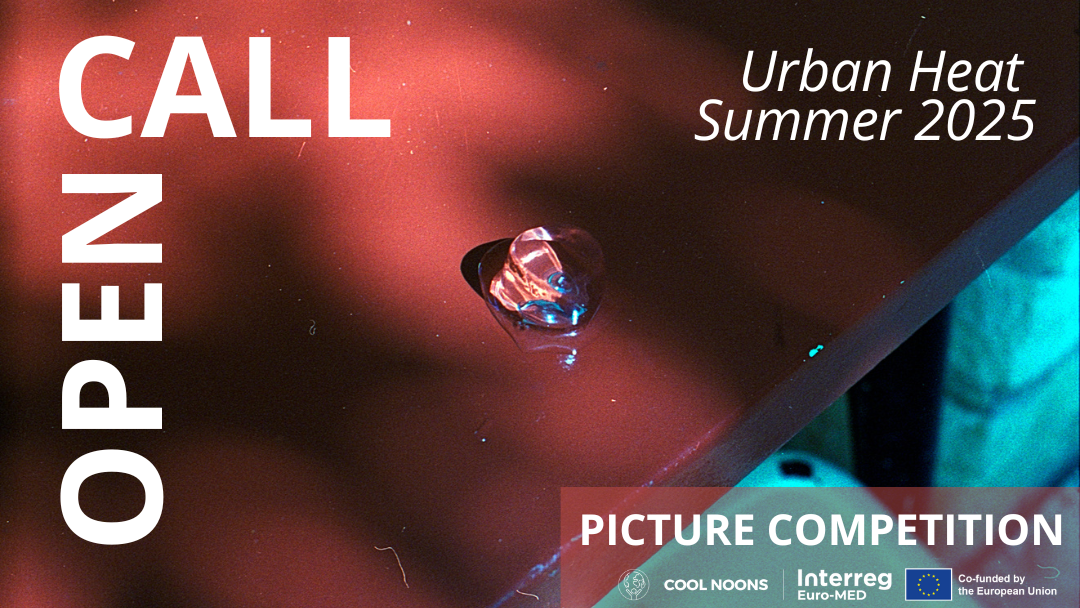
Online picture competition: urban heat in Mediterranean cities
A visual invitation from the Cool Noons Project – open to all.
This is a call to bring forth narratives of climate justice, of relationships with the living, of hospitality, pleasure, care and survival, found in the cracks between mass tourism and the climate crisis.
Cool Noons project organised and launched a call for submissions for all photographers, image-makers, urban wanderers, mediterranean city residents, tourists, and everyday dreamers.
The project, taking place in five European cities – Marseille, Dubrovnik, Lisbon, Imola, and Budva – explores how urban tourism is adapting to climate change, particularly in response to increasingly intense heatwaves.
But rather than taking a purely technical or distant perspective, we aimed to poeticize resistance, to document bodies adapting, gestures that soothe, spaces of refuge, and the inventiveness of daily life under the burning sun.
The thematics that Cool Noons invited to explore through images were, for example, how to improve thermal comfort during the hottest hours of the day; reimagine urban spaces with new uses; how to protect others and leave no one behind.
Projects should document the five Cool Noons cities – Marseille, Dubrovnik, Lisbon, Imola, and Budva – to reveal the social, political, and sensorial dimensions of cities under heat stress.
The call for submissions was open from 07 July to 02 September 2025. All submitters had the opportunity to refine their own project by joining an online workshop held by Kmar Douagi, while the final projects were presented before Sept 30th.
Kmar Douagi is a visual artist and facilitator, whose practice is rooted in documentary and socially engaged approaches. Operating at the intersection of image and narrative, her photographic work explores everyday life – profoundly real, to question, connect and shift our gaze. Investigating the transformative potential of photography through collaborative and transnational initiatives, she is currently a mentee of the Ecole nationale de la photographie in Arles (ENSP).
The workshop – not a lecture – took place in September as a collective and non-hierarchical space, to reflect, share, and shape your visual proposals in dialogue with others.
Cool Noon looked for images that go beyond the lens of tourism – photographs that capture cities as spaces lived, inhabited, and endured. To give voice to the experiences of those who remain when the tourists leave, who bear the brunt of the rising heat, often in unequal ways.
The winners
1st place
Beatrice Canè
Giorno 41
IG: @lab3a
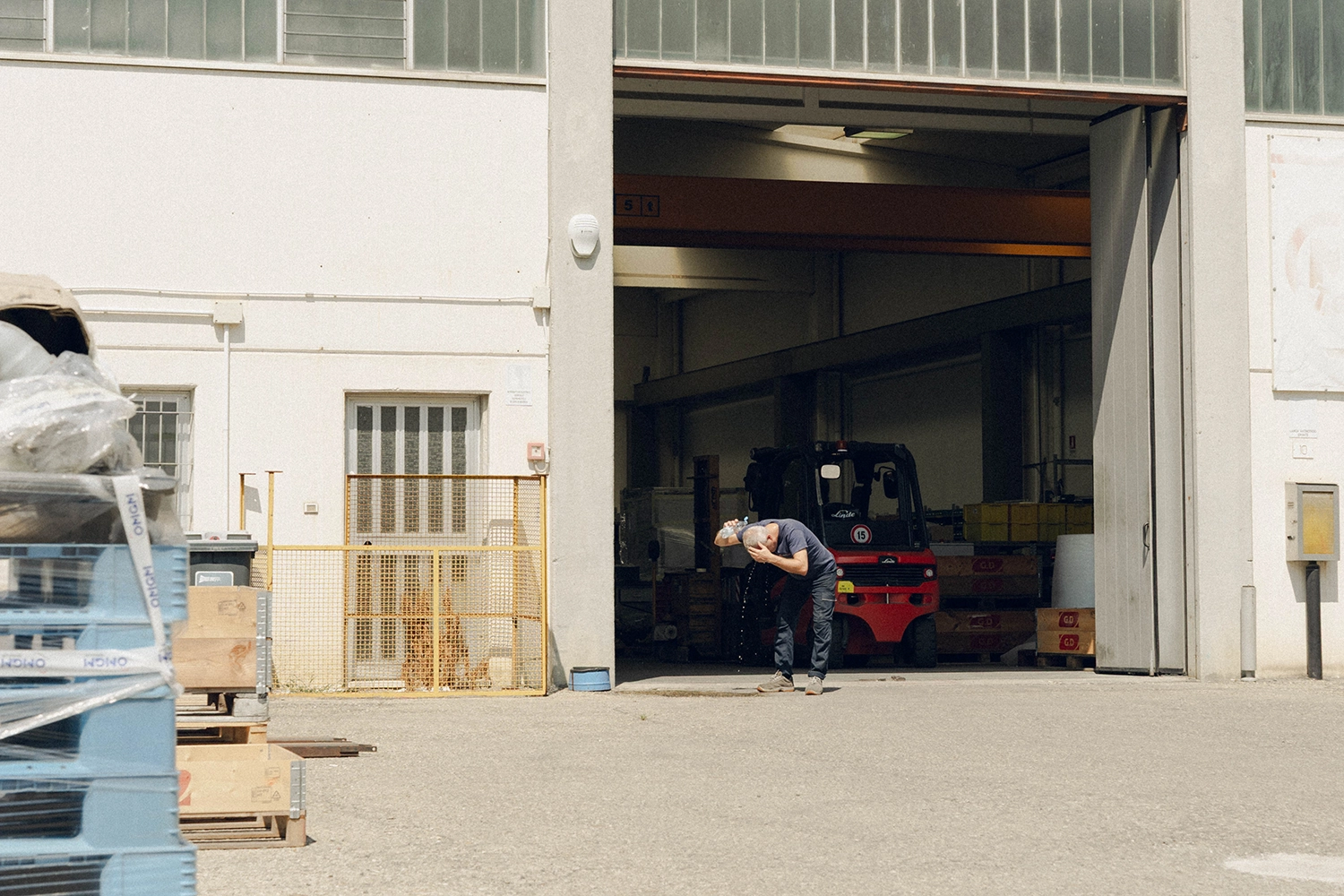
During the hottest hours of summer, the city empties out. Playgrounds, designed to welcome children, become unusable: the metal is scorching hot, the air is still, and the silence becomes thick. It could be any day, or perhaps the exact moment when everyone is playing hide and seek. This project explores absence as a form of presence. It does not show who is there, but where we are not.
Imola, a non-tourist city inhabited largely by elderly people and workers, empties even more in summer. Those who can go elsewhere, those who stay shut themselves in their homes. There is no tourism to fill the voids, no crowds to overwhelm: only the heat and the space that expands in silence.
Through images of suspended public spaces and places where bodies take refuge, playgrounds, community centers, shopping malls, improvised shadows, I recount how extreme heat changes the use of the city and redefines its boundaries. Children stay indoors, adults take refuge at the seaside, and the elderly seek company and relief elsewhere. Some places empty, others fill up. Some resist, others surrender.
The project, entitled “Il tempo in cui ci nascondiamo” (The time we hide), is a visual map made up of voids, objects left behind, and presences held back. It is not a story about the heat, but about what the heat displaces, takes away, and hides.
2nd place
Lalitâ-Kamalâ Valenta
Grey Suns 01 e Gray Suns 02
IG: @lalitavalenta
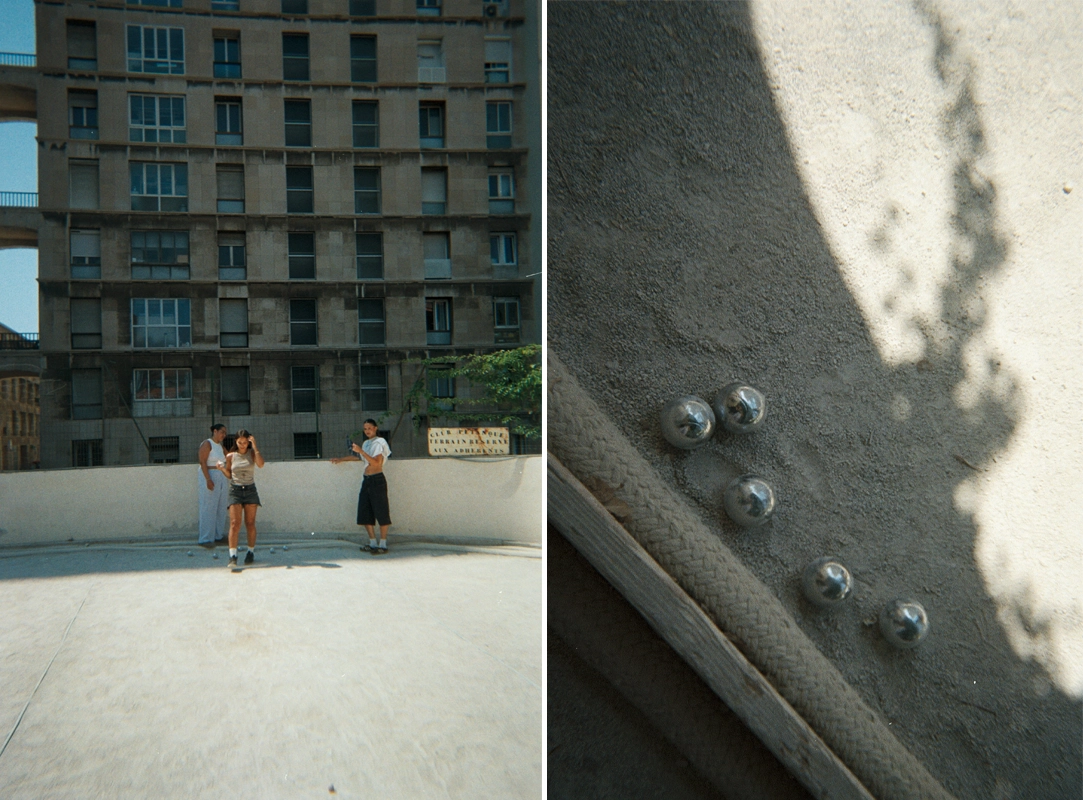
Through this diptych, I would like to show the life of the population who does not have access to pool parties, but only to the territory: its buildings, sea, rocks, sun and shade. The environment needs to be a shared resource, shaping how bodies move, gather, and rest.
In Marseille, the sun is a constant presence and a daily companion. No matter how intense the heat becomes, people continue their routines, traditions, and social interactions, adapting to the conditions rather than escaping them.
This work speaks about play and friendship, but also about resilience and collective adaptation. It focuses on small gestures and shared moments, where being together becomes a way of coping. Heat is not treated as an obstacle, people live with it together, using their environment and each other to create moments of personal relief and joy.
3rd place
Fiona Forte
92 pourcents d’eau, série Chaleur
IG: @fiona.forte
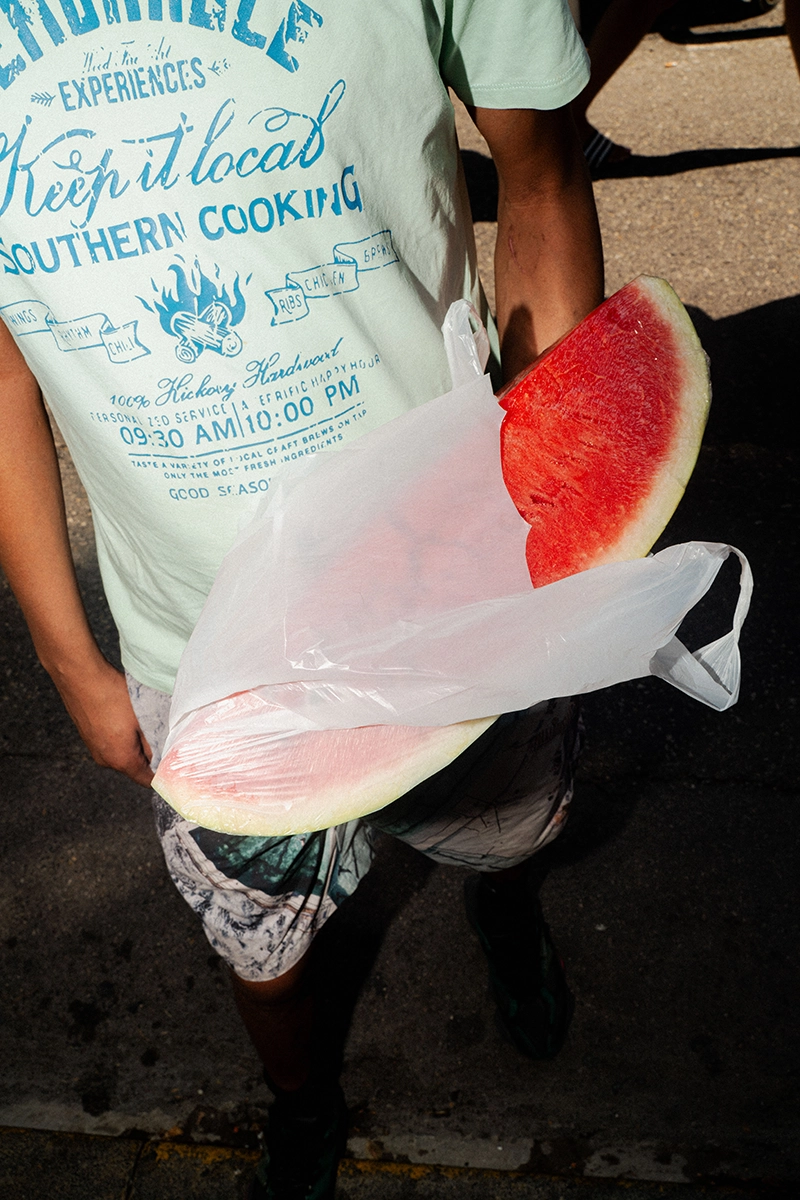
Enveloped by the summer heat, our bodies slide towards the sea. We close our eyes so as not to be dazzled. Languor and pleasure overwhelm us. In Marseille, the rocks stand out, the colors are golden, and the sun beats down. We wait for the heat, we adapt to it, we even migrate to find it. Until when?
Strolling along the beach, I look for what rises to the surface when the temperature reaches new heights. I collect micro-scenes from which flashy postcards emerge: flattened perspectives, saturated colors, the gaze locked in a tunnel vision fixed on the present moment. This narrowing of the frame reflects the political and psychological constraints that are suffocating us.
While the setting is sublime, the actors no longer have faces, and we have almost no control over the staging. The climate is changing, and our attempts to adapt seem futile. So we make room for the carefree attitude we would like to continue to believe in, an illusion where everyone seems both free and imprisoned. Summer has become denial, a tragedy disguised by sunshine, a collective mirage in which we bathe, knowing full well that it will eventually dissolve. When the awakening comes, will we still have our skin?
The exhibition will take place in all 6 countries participating in Cool Noons
Croatia, Dubrovnik
Dubrovnik is showcasing the Cool Noons photo exhibition from April 10th to 24th, with the opening scheduled for around 11:00.
It will take place at the TUP complex: the former Carbon-Graphite and Electrotechnical Products Factory was recently purchased by the City of Dubrovnik with the goal to repurpose it as a hub for the creative sector, SMEs and artists. Part of the space has been specifically adapted for art galleries, making it an ideal venue for our exhibition.
Location address: Ul. Svetog Križa 3, 20000, Dubrovnik, Croatia
Portugal, University of Coimbra
Universidade de Coimbra is one of the oldest universities in Portugal, UNESCO World Heritage since 2013 for its contribution to Portuguese culture, architecture, technology and arts, as well as for its outstanding architecture.
Coimbra University’s lobby will showcase the exhibition in the University’s lobby, dates to be announced soon.
Location address:
Portugal, Municipality of Lisbon
Lisbon, capital city of Portugal, focused its attention on creating green corridors to connect different parts of the city and invite visitors to explore new and wilder areas of the city, such as Parque Florestal de Monsanto (Monsanto Forest Park).
Here, the Monsanto Interpretative Center will host the Cool Noons photo exhibition, from April 18th to May 18th. The Center is open from 9.00 to 17.00 from Monday to Saturday and from 14.00 to 17.00 on Sundays.
Until April 17th, the Monsanto Interpretative Center is hosting the Second edition of the “Monsanto Inspira”, a local photo contest.
Location address: Estrada do Barcal, Monte das Perdizes 1500-068 Lisboa.
Montenegro, Municipality of Budva
The old town of Budva, a jem of the Mediterranean, will be the stage for the photo exhibition. Dates to be announced soon.
Italy, Imola
More to be announced soon! Starting around the beginning of June.
Greece, Athens
The graphic Design Department of the American College of Greece in Athens is preparing to welcome the photo exhibition. It will open right before summer, dates will be announced soon.
France, Marseille
Summer in Marseille is starting with the photo exhibition in Marseille Museum of History. From the beginning of June.
About the Cool Noons Project
Discover the project – from the urban Cool Paths to the catalogue of urban cooling solutions.
For any question, participants can contact coolnoons@interreg-euro-med.eu
Join us in the fight against climate change!
Join us in helping urban tourism destinations to become more resilient to climate change! Find out more about our initiatives, participate in our events, and help spread our mission for a more sustainable future.